Unified Budget Pool Across Meta Google and TikTok
Unified budgets across platforms fix misaligned spend allocation.

- Written by
- Renata Solís-Figuera
- Published
- October 16, 2026
- Reading time
- 10 min read
What this covers
Most advertisers now run Meta, Google, and TikTok simultaneously, yet they budget for each platform as though it were a self-contained channel. The result is a measurement system that systematically inflates performance and misallocates spend. A unified budget pool, governed by a single platform-independent performance signal, is the structural fix the three-platform world demands.
Why the three-platform landscape broke siloed budget management
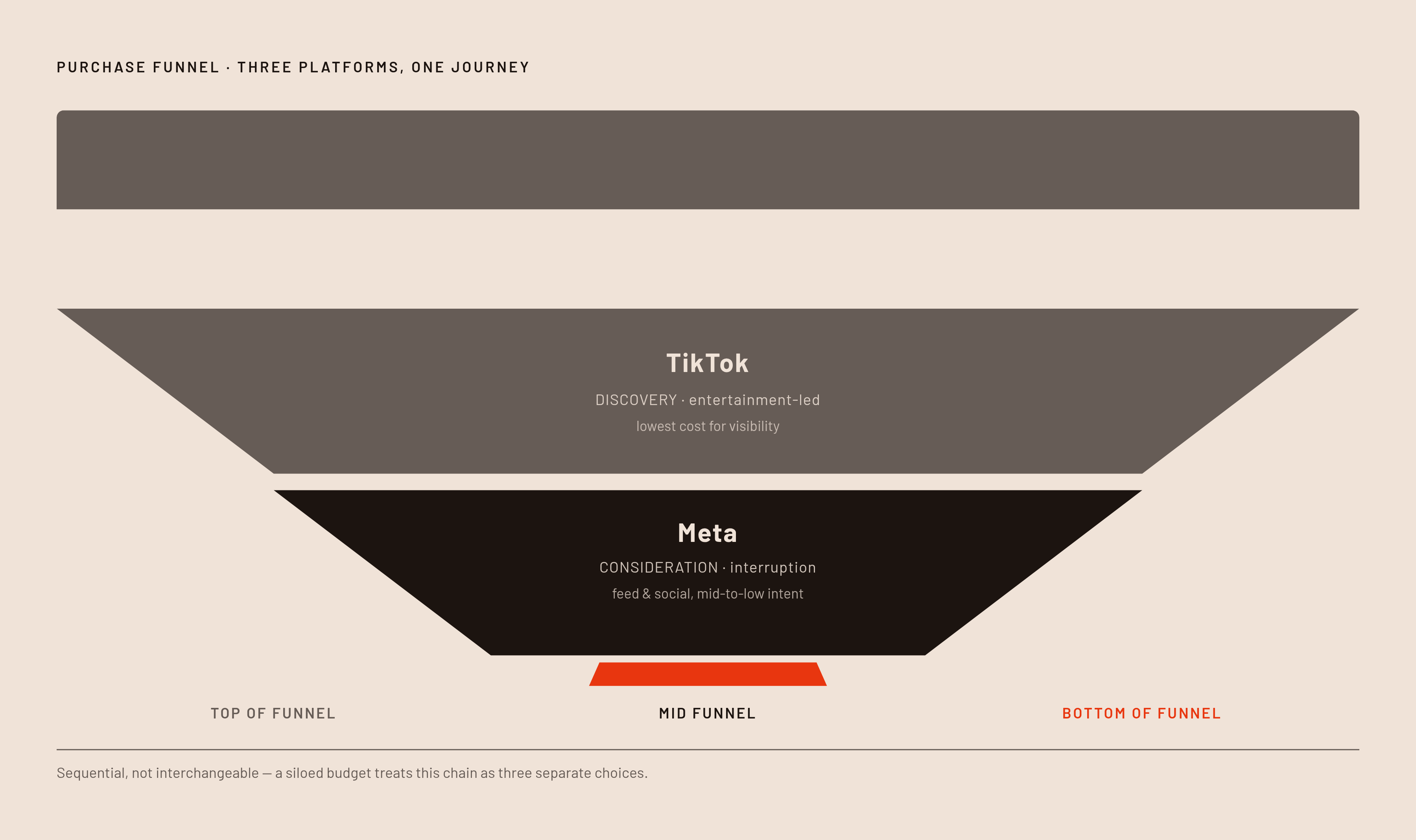
Siloed channel budgets were designed for a simpler environment that no longer exists. The assumption behind them was that each platform could be managed as a discrete unit, with its own targets, its own reporting, and its own channel owner accountable for results. That assumption fails the moment a consumer's path to purchase spans multiple platforms, which is now the default rather than the exception.
Social platforms are not merely riding usage growth. IAB and PwC data recorded US social media advertising revenue in the billions for full-year 2025, growing at more than double the rate of total US digital advertising over the same period. That divergence signals that Meta and TikTok are extracting more ad revenue per minute of attention, not simply adding users. The commercial gravity of the three-platform world is intensifying, and it is doing so unevenly.
Each of the three platforms serves a structurally different moment in the purchase journey. Google Search answers active demand, because it captures users who have already formed intent through a typed query. Meta interrupts and creates demand across feed and social surfaces, reaching people who are not yet looking for the product. TikTok generates discovery and entertainment-led demand at the top of the funnel. None of these functions substitutes for the others, which means a single consumer journey routinely touches all three platforms in sequence.
A budget structure that treats each platform as self-contained is therefore misaligned with how buyers actually move. Siloed management compounds the problem by forcing each channel owner to justify local ROAS against their own platform's reported figures, figures that are systematically inflated in ways the next section will make concrete. The structural mismatch is not a matter of preference. It is a condition of the market, and it carries a measurable cost. For Tiny advertisers running both platforms, TikTok now takes 44% of the budget.
How platform-native reporting inflates ROAS and corrupts allocation decisions
Meta, Google, and TikTok each claim credit for the same conversion when they measure performance against their own attribution models. Reported revenue across Google Ads and Meta combined routinely reaches well above what a store's own system of record captures, so you get phantom ROAS that flatters every channel at once. Every allocation decision made on top of that foundation is unreliable.
The incoherence is structural, not merely imprecise. Each platform uses different attribution windows, metric definitions, and reporting methodologies, so when you compare their native reports against one another you get figures that cannot be reconciled. Meta made reconciliation harder still when it removed 7-day view and 28-day view attribution windows from its Ads Insights API in January 2026. The change narrowed the window in which Meta claims credit, but it also shifted the baseline advertisers had used for historical comparison.
A documented case makes the stakes concrete. When a geo holdout experiment was run on one brand's spend on a separate platform, the platform's own dashboard reported ROAS varying widely depending on the day and reporting period. A separate attribution tool reported a different figure. The measured incremental lift was zero, meaning the spend was generating no causal sales at all. That finding saved the brand a significant sum annually, and it illustrates precisely why platform dashboards cannot serve as the basis for cross-platform allocation.
Signal loss compounds the distortion. Apple's App Tracking Transparency and browser-side tracking restrictions have cut off a substantial share of cross-app tracking, and ad blockers run for a large portion of users. Browser pixels therefore systematically under-report conversions, which in turn distorts the cost-per-acquisition figures advertisers use to set allocations. The practical consequence is that a unified measurement layer is not a refinement. It is a prerequisite for any allocation decision that can be trusted.
What a unified budget pool is and how it differs from a blended budget
A unified budget pool is not a blended total that gets divided by instinct or historical habit. It is a governance structure in which spend is allocated dynamically across Meta, Google, and TikTok based on a single, platform-independent performance signal. The distinction matters because blending budgets without changing governance reproduces the siloed outcome under a different name.
The key structural difference lies in where allocation authority sits. In a siloed model, each platform's budget is set in advance and defended by the channel manager responsible for it. In a unified pool, the total budget is set, and allocation shifts toward wherever the independently measured marginal return is highest. That shift requires three things a blended budget does not: a first-party data layer that attributes conversions once, a measurement methodology independent of any single platform's reporting, and a governance process that can move budget across platforms faster than a quarterly planning cycle.
The pool does not flatten the functional differences between platforms. Google Search still captures intent demand, Meta still creates social demand, and TikTok still generates discovery. What changes is the routing logic. Dollars go to each platform according to what is actually producing incremental outcomes at a given moment, not according to what each platform reports about itself. Audience redundancy becomes a direct efficiency argument for the structure rather than a measurement problem to be managed after the fact.
Where each platform actually performs and why allocation must reflect those differences
The right allocation across Meta, Google, and TikTok is not a fixed split. It is a function of funnel stage, vertical, and spend scale, and the performance data on where each platform actually contributes makes that case more precisely than any rule of thumb. Google Search operates at high-intent demand capture, where a typed query signals proximity to purchase. Meta interrupts and creates demand at mid-to-low intent. TikTok generates entertainment-led discovery at the top of the funnel, with the lowest cost for visibility and traffic.
The lead-generation data is especially important for a unified pool argument. Two platforms at similar spend with very different cost per lead is the kind of signal a siloed model cannot act on quickly, because each channel manager optimizes within their own budget rather than against the portfolio. Vertical ROAS differences are the strongest argument for dynamic rather than fixed allocation, because they show that the economically correct split varies by context in ways no static plan can anticipate.
Spend scale imposes a third constraint. Brands below a threshold in annual spend typically must concentrate on Meta and Google to establish unit economics before TikTok's creative infrastructure requirements, including UGC pipelines, creator relationships, and rapid content iteration cycles, can be sustained. Above that threshold, TikTok becomes a meaningful allocation rather than a test line. The actual distribution in a large tracked dataset reflects this logic. Common Thread Co's Q1 2026 benchmark, tracking hundreds of millions in real ad spend, found Meta commanding the largest share of total spend and Google the second largest, with TikTok a small fraction. Yet growth-stage brands in verticals with genuine platform-product fit run TikTok at a share many times higher than the aggregate median.
The measurement infrastructure a unified pool requires before it can function
A unified budget pool that relies on platform-native reporting to decide where to move money will reproduce the same attribution inflation problem it was designed to solve. The measurement layer must be independent, first-party, and calibrated to spend scale. Three methods serve different roles and different time horizons. Marketing Mix Modeling is best suited to quarterly and annual allocation decisions across all channels including offline. Incrementality testing is the standard for proving causal lift before scaling spend on a given channel. Multi-touch attribution remains useful for daily campaign-level optimization within channels that have already been validated.
No single method is sufficient on its own. MMM without incrementality testing can be slow to detect changes. Incrementality testing without MMM lacks the cross-channel view. Attribution without either can be gamed by platform-reported figures. The appropriate combination changes with scale. At lower annual spend levels, selective incrementality tests plus attribution are usually sufficient. As spend grows, a proper MMM run becomes warranted. At the highest spend levels with an omnichannel mix, all three methods working in concert are required.
Server-side conversion tracking and first-party data enrichment have become prerequisites because browser-pixel-based tracking misses a large share of conversions in a post-ATT, cookie-restricted environment. The cost-per-acquisition figures you use to drive allocation decisions must reflect actual recorded sales, not what the pixel captured. CFO and CEO expectations have shifted accordingly: marketing measurement is now expected to be experimentally validated, privacy-resilient, and refreshed continuously rather than annually. A unified pool that cannot produce that kind of evidence for each platform's incremental contribution will not survive a budget review. The geo holdout case cited earlier is an example of incrementality testing functioning as designed. The unified pool's governance depends on being able to make exactly that call. By restructuring targeting to minimize overlap, brands achieved a 16 to 23 percent improvement in blended customer acquisition cost within one quarter.
How to implement a unified pool in practice: governance, reallocation triggers, and platform AI management
A unified pool requires you to solve three operational problems that siloed management never had to face. First, who has authority to move budget across platforms. Second, what signal triggers a reallocation. Third, how to manage the competing demands of three platform AIs that each resist having their budgets reduced.
Governance structure is the first problem. The pool needs a single owner or decision-making body with authority across all three platforms, not a committee of channel managers each defending their allocation. The most common failure mode is a nominally unified pool that reverts to siloed defense at the first sign of a channel losing budget. Reallocation triggers should be defined in advance and tied to the independent measurement layer, not to platform-reported ROAS. A meaningful drop in incrementally validated return on a channel, a significant shift in cost per lead, or a documented audience saturation signal are the conditions that warrant moving dollars.
Platform AI management is the most underestimated operational challenge. Meta's Advantage+, Google's AI Max for Search, and TikTok's automated campaign products each optimize toward their own platform's objective, and each will resist budget reduction by producing short-term metric improvements that look like performance but may not be incremental. The unified pool's governance must be able to override platform-reported signals when the independent measurement layer disagrees. TikTok's budget share warrants a specific operational note. Its creative infrastructure requirements are qualitatively different from Meta and Google: native short-form video, creator-style content, and rapid iteration cycles. Brands that allocate budget to TikTok without the content pipeline to support it typically see poor results that are attributed to the platform rather than the creative gap. The pool's governance should gate TikTok allocation increases on creative readiness, not just on budget availability.
The strongest objection to unified pooling is operational. Moving from single-platform to multi-platform management is not a linear increase in complexity. A genuine unified pool requires centralized governance of three competing platform AIs, cross-platform measurement infrastructure, and a reallocation cadence that is faster than a quarterly planning cycle. The operational investment is real and should be scoped honestly. The answer to this objection is not that the complexity is overstated. It is that the alternative, siloed budgets producing inflated attribution and redundant audience overlap, also has a cost, and that cost grows as total spend increases. The complexity of unified management is a one-time structural investment. The waste of siloed management compounds continuously.
How Fospha approaches unified cross-platform measurement and budget allocation
The measurement and governance problems a unified pool requires solving, independent attribution, incrementality validation, and a cross-platform view, are the problems Fospha is built to address for Meta, Google, and TikTok advertisers. Fospha provides cross-channel measurement that operates independently of platform-native reporting, so you get a single source of truth for performance across the three platforms. That is the foundational requirement for a unified pool that can make reallocation decisions based on evidence rather than platform claims.
Fospha's platform overview states that it accurately attributes credit across the full funnel and surfaces directly comparable CPAs across platforms like Meta, TikTok, Google, and Amazon. Its April 2026 press release positions the company explicitly against tools that provide platform-reported data produced by the channels being measured, describing Fospha as independent measurement built to be trusted. The platform works with first-party data and aggregated measurement signals, combining them with Daily MMM to deliver compliant, cookieless insights. Those cost-per-acquisition figures reflect actual recorded outcomes rather than pixel-captured proxies, so they directly address the signal-loss problem that undermines cross-platform comparisons. For teams managing the operational complexity of unified pool governance, Fospha's always-on measurement cadence supports the continuous performance validation that CFOs and CEOs now expect from marketing investment.