Google Ads Conversion Lag and How It Distorts Campaign Decisions
Delayed conversions silently undermine bidding strategy and campaign performance assessments.
- Written by
- Daniel PrzybylskiStaff Writer, Measurement
- Published
- October 9, 2026
- Reading time
- 10 min read
What this covers
Conversion lag is the single most underdiagnosed distortion in Google Ads reporting: every recent performance window an advertiser looks at is reading an incomplete dataset, by design. The fix is a discipline of knowing how much of the picture is still missing before acting on what's visible.
Why recent Google Ads data always understates true performance
Google Ads attributes every conversion to the date of the original click, not the date the conversion actually happens. The practical result: Monday's numbers look worse when checked on Tuesday than they will when checked again on Friday, simply because more of Monday's conversions have had time to arrive.
The length of this lag isn't fixed. Only the completeness of the data changed.
The default 30-day attribution window's mismatch with most business types
Google Ads ships with a default 30-day conversion window, and if your purchase cycle is short, like retail, that window fits well. Most conversions settle within the first week, so the default window captures nearly the full picture.
That same default becomes a liability the moment the purchase cycle runs longer than 30 days, and for a large share of B2B and considered-purchase advertisers, it does. B2B manufacturing and enterprise sales push this further still, with cycles running many months; the default window captures only a fraction of the conversions those campaigns eventually generate, leaving the account looking perpetually underpowered no matter how well the campaigns are actually performing.
A second, compounding layer appears when an account uses GA4 as its primary conversion source. Running both platforms side by side creates a built-in discrepancy between the two, one that can look like a sudden decline in one system relative to the other when both are, in fact, reporting correctly according to their own attribution logic.
What incomplete conversion data does to Smart Bidding
Smart Bidding treats whatever conversion data it has received as the full truth of what's happening in an account, so lag becomes an algorithmic problem, not just a reporting one. Strategies like Target ROAS, Target CPA, Maximize Conversions, and Maximize Conversion Value all work by predicting which clicks are likely to convert and adjusting bids in real time. That prediction model calibrates only on conversions it has actually received, never on conversions that still sit inside the lag window waiting to post.
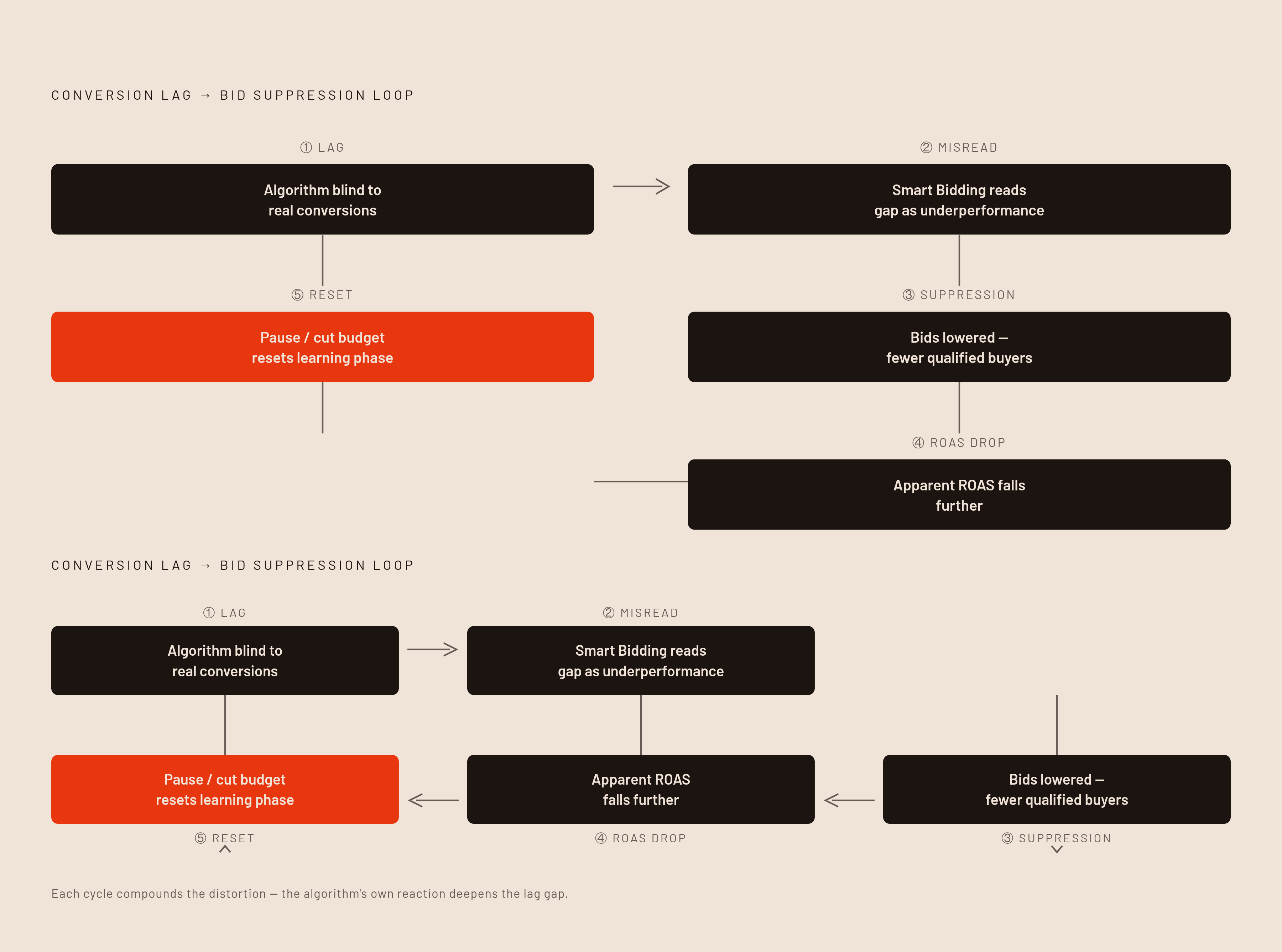
When lag hides a chunk of real conversions from the algorithm, the algorithm reads the gap as genuine underperformance. It responds by lowering bids, so it reaches fewer qualified buyers, and apparent ROAS drops further as a result. An advertiser watching this unfold sees a declining trend and reasonably assumes the campaign is weakening, when part of what's actually happening is the algorithm reacting to its own incomplete signal.
That reaction tends to compound. The cycle doesn't resolve on its own. It resolves only once the lag window catches up and the missing conversions finally post, by which point real budget has already been spent bidding too cautiously. Smart Bidding needs a healthy volume of conversion events to calibrate well, and a campaign that's actually running at strong volume but only showing a fraction of its true conversions at any given moment gets treated by the algorithm as a low-data account, with all the conservative, less efficient bidding that status implies.
This matters for nearly every advertiser now, not a subset of them. Maximize Conversions with optional Target CPA, and Maximize Conversion Value with optional Target ROAS, are the default bid strategies in most Google Ads accounts today. Lag-corrupted early data feeds straight into algorithmic bidding decisions whether or not an advertiser consciously opted into automation.
The three campaign decisions conversion lag most reliably corrupts
Three specific, recurring decisions get corrupted by conversion lag more reliably than any others: pausing a campaign that's actually winning, cutting a budget right after scaling it, and resetting the Smart Bidding learning phase at precisely the wrong moment.
The pausing error plays out in a predictable pattern. The budget got pulled from the winner precisely because lag hid its results at the moment the decision was made. This happens routinely to e-commerce stores selling higher-AOV products, where research cycles run longer and week-one data is structurally too thin to judge anything by.
The scaling error is sharper and more common. Google Account Executive Konstantinos Papadopoulos described the pattern in a July 2025 LinkedIn post, noting that 7 days after scaling by 50%, the metrics had worsened. The worsening metrics in that scenario are lag. Assess the same period again a week later and the CPA looks dramatically different: same spend, same days, a different number, because the conversions finally had time to settle.
The third failure compounds the first two. Pausing a campaign during its lag window resets the Smart Bidding learning phase. Google's own documentation is explicit that Smart Bidding needs time and a sufficient number of conversion events to calibrate, and a campaign paused before that calibration completes never gets the chance to prove itself.
B2B Accounts and Offline Conversion Importers Face the Worst Version of This Problem
The damage from conversion lag scales with two things: how long the gap runs between click and conversion, and how much additional delay the data pipeline itself introduces. B2B advertisers and anyone relying on offline conversion imports sit at the intersection of both, which makes this the environment where lag does the most structural harm.
B2B SaaS accounts often have research-to-decision cycles that run far past any default attribution window. Conversions attributed within that window represent only a slice of the deals those original clicks actually produced, so Smart Bidding ends up optimizing against a picture that is systematically incomplete, not just occasionally delayed. The structural response many of these accounts use is a micro-conversion ladder: instead of waiting for a closed-won signal that arrives too late to be useful for bidding, the algorithm gets fed earlier pipeline events, an MQL and then an SQL, each assigned a value reflecting its relative contribution to eventual revenue. That gives Smart Bidding a usable signal on a realistic timeline while it still optimizes toward the outcomes that matter most.
Offline conversion importers face a parallel problem, and it comes from mechanics, not sales cycle length. Import frequency determines how quickly real conversions reach the algorithm. A weekly import leaves the account working from data that's stale relative to the spend generating it almost all the time.
One instructive case: a SaaS company shifted its primary conversion event from trial signups to CRM-stage offline conversions, a more meaningful signal tied closer to actual revenue. Its dashboard conversion count fell sharply in the first two weeks after the change because the new signal carried a longer natural lag than the one it replaced, not because performance had declined. The account looked worse at the exact moment it had started measuring itself more honestly, a trap that catches advertisers doing the right thing just as easily as those doing the wrong one.
The objection that Google's algorithm already corrects for lag
Smart Bidding does apply adaptive weighting to account for conversion delay, and that correction is real within its limits. Google's interface also surfaces projected additional conversions expected to arrive within the delay window, and reading that projected figure rather than the raw reported number is the workflow Google intends. If an account has a correctly configured conversion window and healthy volume, this self-correction works largely as designed.
The mechanism breaks down under two specific conditions, and both are common. First, when the attribution window is shorter than the account's actual conversion cycle, the algorithm can only train on conversions it has seen. Conversions that fire after the window closes never arrive at all, and adaptive weighting has no way to compensate for data that simply doesn't exist in the system. Second, low-volume accounts face a compounding version of the same limitation: the adaptive model needs a sufficient base of historical conversion data to weight correctly, and accounts that fall below the volume threshold Smart Bidding needs for reliable calibration end up with neither accurate current data nor a well-trained historical model to fall back on.
Reading conversion lag in your own account
Google Ads gives you tools to measure lag with precision, but most advertisers never open them. The Time Lag report, found under Tools, then Measurement, then Attribution, then the Time Lag tab, shows the actual distribution of how many conversions in the account arrive on day one, day two, day seven, and beyond. The report shows the account's real lag profile.
The Bid Strategy Report offers a second view, one specific to accounts on Target CPA or Target ROAS. If you select a campaign and set the time frame to the last 14 days with a daily interval, a blue, semi-transparent line appears beneath the performance chart, marking which days still have incomplete conversion attribution. Those marked days need to be excluded from any formal performance judgment, full stop, because their numbers are not yet final.
A third view comes from segmenting by days to conversion. In the Campaigns, Ad groups, or Search Keywords tab, the Segment icon offers Conversions, then Days to conversion, which shows precisely how many conversions arrived on each day following the click. This makes it possible to state, with real precision, how much of a campaign's total eventual impact is visible at any given point in time.
Path metrics, under Goals, then Measurement, then Attribution, then Path metrics, separate timing patterns by conversion action. This distinguishes high-consideration conversions like purchases and B2B leads from low-consideration actions like newsletter signups or downloads, because a single account can carry very different lag profiles across its different goals at the same time.
Adjusting evaluation windows, bidding configuration, and reporting hygiene to account for lag
Correcting for conversion lag requires action at three levels: how the attribution window is configured, how the bidding strategy is structured, and how performance gets evaluated. Each level reinforces the others, so treating any one of them in isolation leaves gaps the other two will eventually expose.
On the configuration side, the conversion window should match the account's actual conversion cycle rather than Google's default, with the Time Lag report supplying the evidence for where that true cycle actually falls. If your sales cycle genuinely exceeds any attribution window Google supports, you can assign values to earlier pipeline events like MQLs and SQLs and feed those to Smart Bidding, and this micro-conversion ladder becomes the structural fix that keeps the algorithm trained on signal that reflects reality.
On the bidding side, Smart Bidding needs a sufficient volume of conversion events to calibrate reliably, and when lag is suppressing apparent volume below that threshold, consolidating campaigns to pool signal can push the account above the threshold on its actual volume. When scaling a budget, build in a deliberate buffer period before judging the results: scaling always produces a temporary cost-per-conversion illusion that resolves once the conversions attributable to the new spend have had time to arrive.
On the reporting side, lag-incomplete days need to be excluded from any formal evaluation, and the Bid Strategy Report's blue-line indicator is the practical tool for identifying exactly which days to drop before calculating CPA, ROAS, or conversion rate for a period. Reporting that states historical lag percentages directly, what share of conversions typically arrive within seven days, within fourteen, within thirty, turns lag from a hidden variable into a quantified expectation that stakeholders can actually reason about.
Beyond measurement and structure, the speed at which conversions settle can itself be improved. If you're an offline conversion importer, increasing import frequency shortens the gap between when a conversion actually happens and when it reaches Google Ads, so daily imports get real signal to the algorithm meaningfully faster than weekly ones do.
The rising stakes as manual bid controls narrow
Google continues removing manual bidding controls, and Smart Bidding has become the effective default across the platform's major bid strategies. That shift leaves the quality of the conversion signal an advertiser provides as the primary remaining lever over campaign performance, which makes managing lag a strategic necessity.
If you haven't deliberately configured an alternative bidding approach, you are already running automated bidding trained on whatever conversion data your account produces, lag-corrupted or not. Platform changes active in 2026 extend this further: AI Max for Search came out of beta on 15 April 2026, and Performance Max continues routing higher-intent queries away from traditional Search campaigns. The automation layer is expanding its reach into more of the account, not receding from it. The algorithm is making a larger share of the decisions that used to belong to a human.
The practical consequence follows directly. An advertiser feeding the algorithm accurate, lag-corrected conversion data, with a correctly configured window and sufficient volume, is working in concert with the system. An advertiser feeding it incomplete, lag-distorted data is competing against their own automation, with the machine working to undermine the campaigns it's supposed to be optimizing. The inputs still under an advertiser's control, the conversion window, the signal quality, the campaign architecture, the definition of what counts as a conversion and what value it carries, are exactly the inputs lag management touches directly. Getting them right is the primary job now, not incidental housekeeping around the edges of an account.
Implementing Enhanced Conversions with first-party revenue data is one concrete way to act on this. It aligns the conversion value the algorithm sees with actual profit, giving Smart Bidding a signal that reflects business reality even where lag might otherwise distort it. The accounts that treat conversion signal quality as foundational, rather than incidental, are the ones whose automated bidding decisions can actually be trusted.