Broad Match Keyword Spend Leakage in Google Search
Google's default broad match setting wastes ad spend on unrelated search queries.

- Written by
- Taryn Osei-MensahSenior Contributing Editor
- Published
- October 9, 2026
- Reading time
- 9 min read
- Sources cited
- 1 sources ↓
What this covers
If an advertiser selects a conversion-based Smart Bidding strategy, Google has set the new Search campaign to broad match by default since July 2024. That single switch changed what every new campaign inherits on day one: maximum query discretion handed to Google, not chosen by the advertiser but assumed unless someone actively turns it off. The override is easy to miss in practice. An advertiser can type in phrase match or exact match keywords and click save, but Google Ads quietly discards those match types because the campaign-level broad match setting overrides them. The keyword list the advertiser built no longer governs what the account buys.
The default has kept expanding since. AI Max for Search moved through beta globally starting in May 2025, and it reached full global availability in the third quarter of that year. It matches queries beyond the current keyword list, combining broad match with keywordless targeting, so the keyword list stops being the boundary of where money goes. Other features Google ships turned on by default, like automatically created assets and final URL expansion, add to this without requiring a single advertiser decision. Then, on August 3, 2026, Google stopped allowing the creation of new campaign-level broad match campaigns and legacy Automatically Created Assets campaigns across the interface, Google Ads Editor, and the API. That freeze matters for a specific reason: it means the accounts carrying this exposure are no longer a moving target. They are a fixed, countable population, built before the cutoff, running on a setting advertisers can no longer newly select but many are still living inside.
How broad match's matching logic creates the query gap
Match types work like permission levels. Exact match sets a tight boundary around intent. Phrase match allows variation around a core meaning while keeping that meaning intact. Broad match weighs context instead of matching the literal words in the keyword field, so it hands Google the widest possible room to guess what a searcher actually wants. That discretion is precisely where the space opens between the query an advertiser meant to buy and the query the system actually serves.
The consequence appears in real accounts. A person doing research can trigger an ad built for a buyer ready to purchase. The account records the click, the dashboard shows a bump in engagement, and the sales pipeline gets nothing out of it. One practitioner running the keyword "blue runner sneakers" on broad match found the search terms report filling with "running socks," "blue paint runner," and "sneaker cleaning," burning through budget before anyone caught the pattern. None of those terms are random noise. They are semantically close enough to the original keyword that Google's matching logic considers them structurally eligible, even though commercially they have nothing to do with someone shopping for sneakers.
A fair objection follows from here: Google's language models have gotten much better at reasoning about intent, going beyond comparing strings of text. BERT entered Google's systems in 2019, and MUM followed with deeper integration into match-type logic from 2021 onward. Doesn't that kind of language modeling fix the problem on its own? It improves the signal, but it does not close the gap. What changes is the location of the error. Instead of a crude lexical mismatch, the system now makes intent-inference mistakes, guesses about what a person wants that turn out to be wrong. Those errors are harder to spot in a search terms report and harder to correct, because they look like reasonable inferences.
How bad query matches corrupt future decisions
Wasted spend from a mismatched click is the smallest part of the problem. The larger cost is what that click does to the data an account relies on for every decision that follows. Search term reports filled with mixed-intent queries become the raw material for keyword expansion, ad copy testing, and landing page decisions. When that raw material is corrupted, every decision built on top of it starts from a false premise.
The diagnostic tool advertisers depend on to catch this is getting less reliable at the same time broad match's footprint is growing. Google has signaled that some of the search terms shown in the report may not represent the exact query a user typed. Advertisers reviewing that report may not be seeing the full scope of the mismatch they are trying to catch. AI Max makes this more urgent rather than less: because it matches beyond the keyword list by design, a weekly review of the search terms report stops being optional. But reviewing a report whose own fidelity is in question only gets an advertiser partway to the truth.
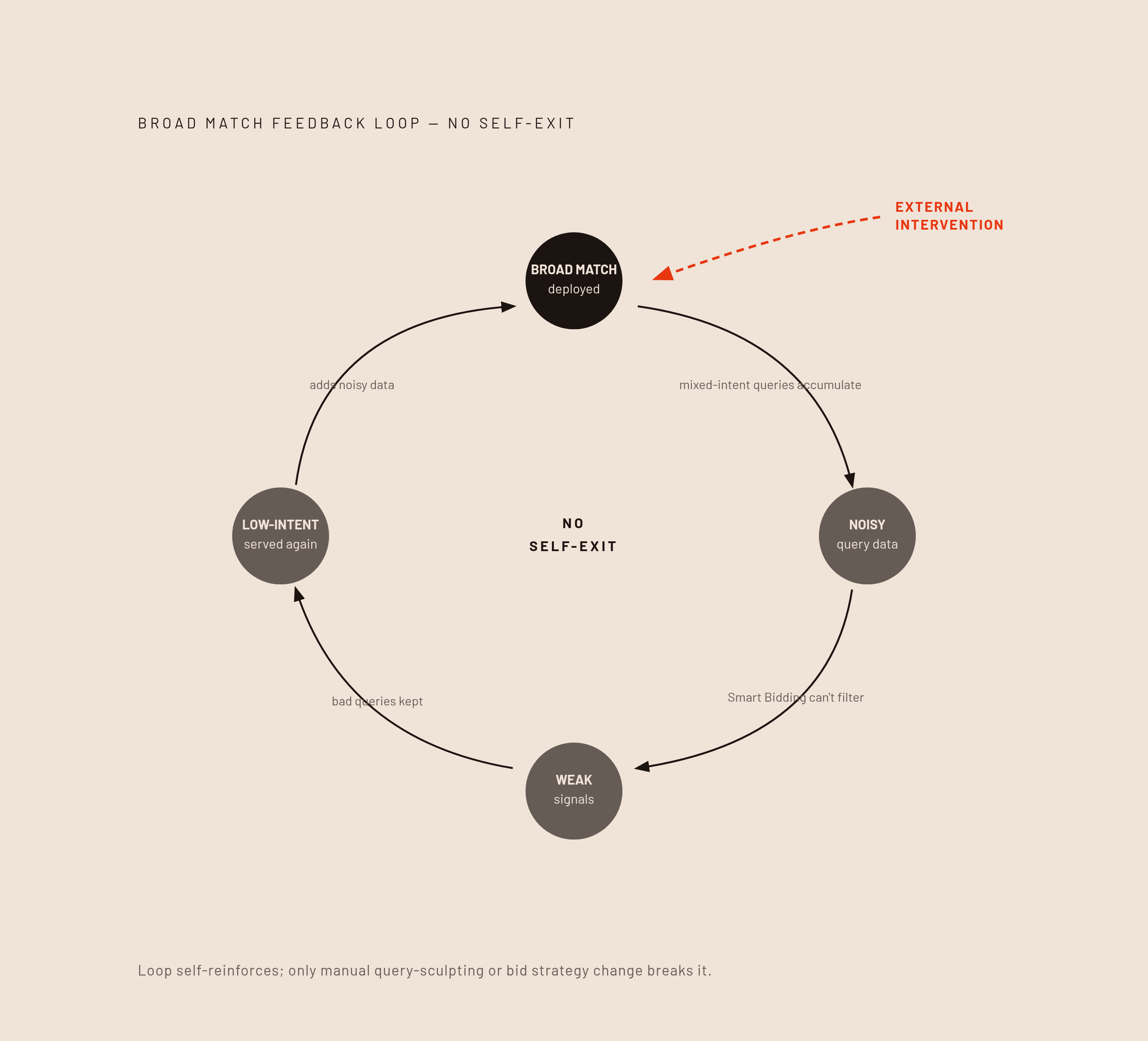
The compounding runs in a loop. Broad match deployed into a low-conversion account produces noisy query data. Noisy data produces weak conversion signals. Weak conversion signals leave Smart Bidding without the information it needs to learn which queries to filter out. Without that learning, Smart Bidding keeps serving the same low-intent queries it was already serving, and the account keeps accumulating the same kind of noisy data that caused the problem. Nothing in that loop self-corrects without an outside intervention.
When Broad Match Works
Broad match is not a flawed idea. It performs well under specific, documented conditions, and dismissing it outright would misstate the evidence. The accounts most likely to accept broad match as a default without reviewing it, meaning small-budget accounts, new accounts, and accounts without dedicated management, are also the accounts least likely to generate the conversion volume that lets the system self-correct. Smart Bidding needs enough conversion data to learn which queries actually lead to sales. An account running a handful of conversions a month gives the algorithm almost nothing to learn from, so broad match defaults to semantic expansion instead of intent filtering, and semantic expansion is exactly where the commercially wrong matches get in.
A mature negative keyword list is the second prerequisite, and it is just as commonly missing. Broad match without a disciplined negative list is understood across the industry to waste a meaningful share of spend in a campaign's first month, before anyone has had the chance to build out the exclusions that narrow the system's guesses.
When both conditions are actually met, the results justify the approach. A six-month experiment run by Triple Dart found that broad match delivered the majority of conversions on roughly half the budget that other match types required. That outcome depended entirely on having the conversion volume and the Smart Bidding maturity already in place. Strip those conditions away, which is what the default setting does for most new or small accounts, and the same mechanism that produced Triple Dart's result produces leakage instead.
The account patterns that produce leakage
Leakage does not spread evenly across an account. It concentrates in a small number of identifiable patterns, each one answerable by a direct question about how a specific account is actually configured.
Does the broad match campaign have a negative keyword list attached to it? A 12-account audit found that nearly two-thirds of wasted spend traced directly back to broad match keywords running with no negative list paired against them. The same audit found that a single afternoon spent building out negative keywords produced a substantial reduction in wasted spend over the following 30 days, which says less about the difficulty of the fix and more about how rarely it gets done.
Does the campaign have enough monthly conversions for Smart Bidding to work with? When a campaign falls short of the conversion data Smart Bidding needs, Google has no reliable signal to judge commercial intent, so the system falls back on semantic expansion. That fallback is where the gap between an intended query and a served query opens widest.
Has anyone in the account recently accepted a Google interface recommendation to attach a brand inclusion list? This is the pattern to take most seriously, because applying that single recommendation does not just attach the list: it also silently activates the campaign-level broad match setting, converting every existing keyword in the campaign to broad match and handing query-matching priority entirely to Google's algorithm. Marketing Scoop's documentation of this exact behavior has made it a standard reference point for leakage that enters an account without the advertiser making any explicit decision to accept broad match.
Is anyone reviewing the search terms report on a weekly basis for campaigns running AI Max? AI Max matches beyond the keyword list by design, so without that weekly check, the advertiser has no visibility into which queries their budget is actually buying. The cost compounds beyond the direct spend, too: irrelevant clicks drag down click-through rate and conversion rate across the whole account, which makes the real budget impact larger than the wasted click cost alone would suggest.
September 2026's AI Mode experiment and its effect on broad match
The claim that reaching Google's AI surfaces requires broad match has been one of the strongest justifications for tolerating its leakage. That justification weakened considerably with an experiment Google ran in September 2026. Before this experiment, Google's own documentation for AI Overview advertisements pointed advertisers toward broad match or keywordless targeting, because the queries triggering those surfaces tend to be long and exploratory, the kind of searches that benefit from wide matching discretion.
On September 4, 2026, Google's Ads Product Liaison Ginny Marvin described a small experiment that serves text ads from standard Search campaigns using exact match and phrase match keywords inside AI Mode. That represents a real departure from the eligibility rule that had governed the surface up to that point. The experiment applies only to queries carrying explicit, direct user intent, the opposite of the long, exploratory queries that had been used to justify broad match as a requirement for AI surface coverage.
If this experiment expands beyond its current small scale, it removes a structural reason for advertisers to accept broad match's leakage in exchange for visibility on AI surfaces. Advertisers could reach AI Mode placements while they kept exact and phrase match control over their query sets. None of this amounts to a policy reversal yet. It remains a small, bounded test, not a new default. But it is a credible reason to stop treating the claim that broad match is mandatory for AI surfaces as settled fact. Set next to the August 2026 freeze on new campaign-level broad match campaigns, the direction both developments point toward is more structured, more enumerable match control, not less.
What closing the gap requires
Nothing about closing broad match's leakage gap requires new knowledge. The practices that work are well documented. What they require is active management that Google's default account experience does not prompt, encourage, or make easy to find, especially for the smaller and newer accounts most exposed to this setting.
Review search terms weekly and add negative keywords systematically. If accounts keep this up consistently, they can bring broad-match waste down from a high initial share of spend to a low single-digit share within a few months. Conversion tracking integrity has to come before that, not after it: Smart Bidding cannot filter queries well if the conversion data feeding it is inaccurate or incomplete, so fixing leakage starts with auditing what is actually being passed to the bidder, not just which keywords sit in the account. Audience signal hygiene reinforces both: customer match lists that get updated regularly and segmented by purchase behavior give broad match's matching logic the commercial context it needs to favor buyers over researchers. For any account running AI Max, the search terms report review has to happen weekly rather than monthly, because the keyword list no longer defines where the budget actually goes.
None of this is prompted by the interface itself. Google's recommendations push toward broad match, they say nothing when conversion thresholds go unmet, and they ship AI Max and automatically created assets switched on by default. An advertiser who does not already know to look for these gaps will not find them until spend has already leaked out the other side. The leakage is structural, built into how Google's defaults are configured. Closing it is equally structural: it takes a deliberate, ongoing set of decisions on the advertiser's side, made against an interface that was not built to prompt them.
Methodology & sources
- Google Ads Keyword Match Types: 2026 Guide
Provided background on how Google Ads keyword match types work, including the permission-level distinctions between exact, phrase, and broad match that the article uses to frame the query gap.